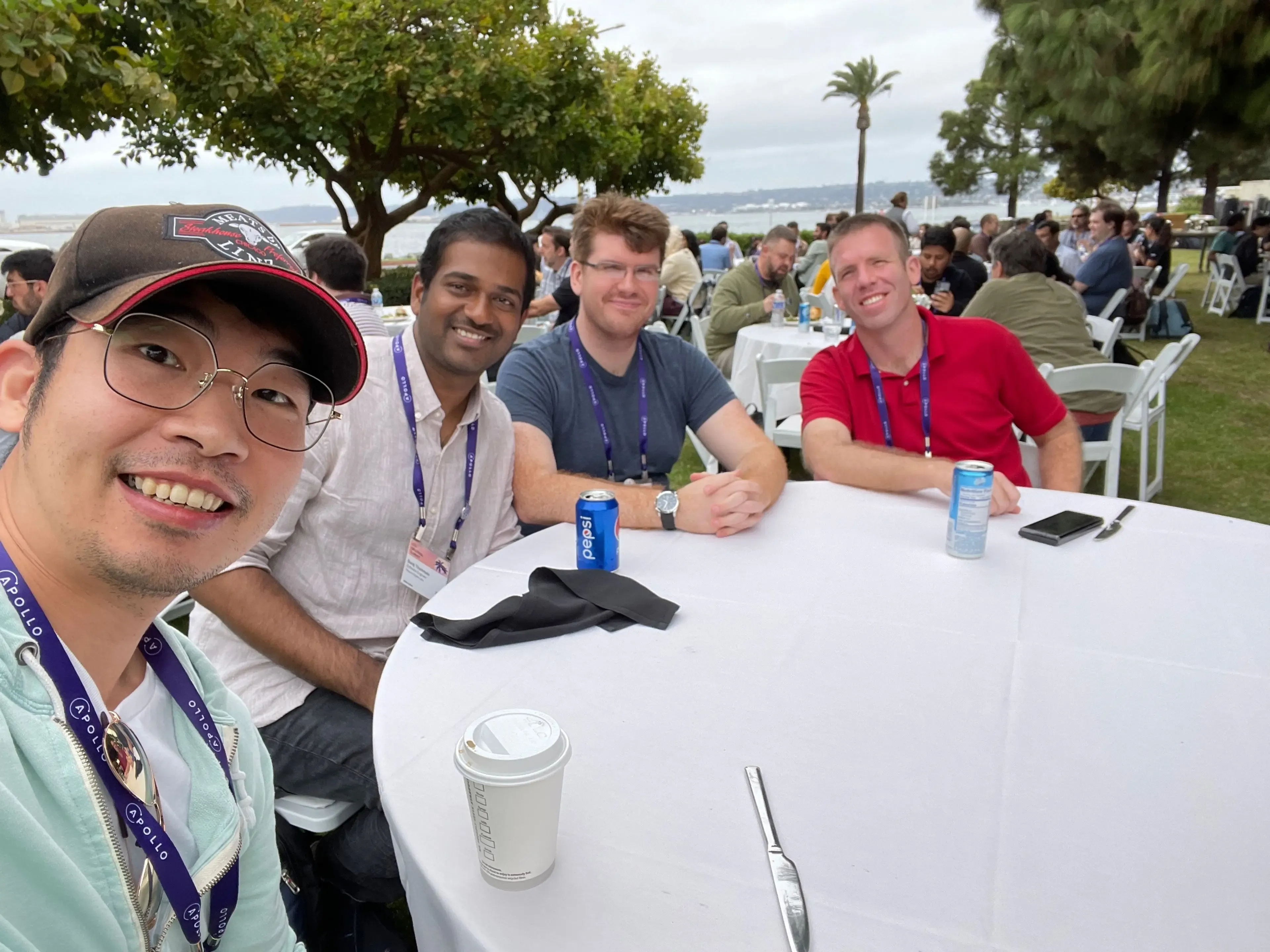
A Bit Background
I've been working from home since March 2020. I've also avoided traveling in the past three years. When Jen, my manager, asked me if I wanted to go to GraphQL Summit 2022, I immediately realized that I should have been outside more often, and I took the opportunity. Besides, there are colleagues I have never met since they were hired during the pandemic.
Talks I Attended
| Talk | Recommend |
|---|---|
| The Champion's Journey | |
| Schema Design | |
| Opening Keynote | |
| Creating Connected Subgraphs | |
| Building Great GraphQL Developer Experiences @ Scale | |
| Escaping GraphQL Monoliths and Embracing Apollo Federation at Fidelity Investments | Yes |
| Navigating the Normalized Cache | |
| Schema Updates on Mobile GraphQL Clients | |
| Steps to Take Until You Remove All the REST | |
| Authorization Patterns in GraphQL | |
| From Graph to Supergraph Scale Fast Without Breaking Anything | |
| The Future of Supergraph | |
| How a Supergraph Powers the Front Page of the Internet | Yes |
| The Future of Real-Time Data in GraphQL | |
| Stranger Graphs Scaling Netflix Financials with Federation & GraphQL | Yes |
| GraphQL is Not a Trap | |
| Designing GraphQL Friendly REST APIs | |
| Netflix's Supergraph Saga Continues: Collaboration @ Scale | Yes |
| What's New in Apollo Server 4 | |
| Apollo Router: The Next Generation Supergraph Runtime | Yes |
| Can We Still Be BFFs | |
| Solving the Two Hardest Problems in Computer Science with GraphQL | |
| How Walmart Redesigned and Unified their Customer Experience in Just 11 Months |
Day 1: Workshops
The Champion's Journey by Dan From Expedia Group
- Champions start from their own early developer experience and lead with empathy — remembering what it felt like before things got easier, staying humble that everything can still be made better, and sharing what you learn along the way.
- Culture matters as much as code. Dan talked about "peeps and culture," leaders, and how many different tribes touch a graph — app teams, service teams, product & design. One stat stood out: it's not typical for front-end teams to own most of the graph work; in his org, service teams own about 80% of it.
- Rolling out GraphQL internally is really an "internal economy" problem — power, "coins of the realm," and who gets to make decisions matter just as much as the technology itself.
- The strongest pitch for GraphQL, in his experience, wasn't performance or DX — it was collaboration.
- Federation raises a recurring fork in the road: do you end up with a fragmented graph, or one mono graph? He pointed to PayPal as an example of navigating that tradeoff.
- Being declarative helps, but there are real pains too — database ownership issues came up more than once, and mindset matters as much as tooling.
- He referenced the "Supergraph" and raised open questions worth sitting with: where does TypeScript fit in, and what logic belongs in lower-level services versus the graph layer?
- His advice for getting started: go from a proof of concept to a small production pilot to prove value — and pick a hard problem to start with, not an easy one.
Schema Design
Day 2
Started the day with a cup from Rugged Coffee before diving into back-to-back talks.
Opening Keynote
- SuperGraph Dev Kit
- Apollo Router 1.0 & Apollo Federation 2
- GraphOS
Building Great GraphQL Developer Experiences @ Scale (Netflix)
- History
- BFFs for different consumers: TV, iOS, web
- 500+ contributors
- 300+ domain graph services
- 3,000+ types
- Challenges
- Design comes first
- APIs are harder to change once they're out
- Schema Registry
- SUPs (Schema Update Proposals)
- Consistency & guidelines
- GraphDoctor, a diff-aware GraphQL schema linter
- Rapid iteration & prototyping
- Variants as a sandbox for integration
- GraphLabs
- Preview environments via Reggie, their graph registry UI
- Design comes first
- Takeaway: federated schema design, a schema linter, and preview environments go a long way at this scale.
Escaping GraphQL Monoliths and Embracing Apollo Federation at Fidelity Investments
- Monolith vs. microservices, framed around a domain capability model (e.g., a chat client)
- What starts to break as you scale:
- Higher TPS
- Errors surfacing from backends
- Data access controls
- Their answer: Apollo Federation, with developer experience as the north star
- Takeaways: improve dev experience, tame graph complexity, improve team collaboration, and reduce merge conflicts
Navigating the Normalized Cache at Wayfair
- Used Android as the example platform
- Framed around network latency and "rage metrics" — rage clicks, scrolling at random ("scrandom"), backtracking
- Idle wait times hurt more than raw speed: how people feel is more important than
actual performance
- Simplified metrics: Speed Index, missed interactions, CLS (layout shift)
- How data flows between navigations, and shared data bindings
- Open problems: TTL management and direct cached-fragment access
Schema Updates on Mobile GraphQL Clients (Apollo GraphQL)
- Mobile apps are strongly typed and ship binaries with the GraphQL schema baked in
- Impact: type conversion and cache-key normalization break when the schema changes
- Mitigation strategies
- Flat, response-based models — didn't work
- Infer type from key fields — worked
- Infer type from naming convention — worked
- Covered implementing type conversions and normalized cache keys
- Future possibility: run-time schema updates
Steps to Take Until You Remove All the REST at Pinterest
- Shared migration stats
- The big-picture problem: is there a reusable component or a repeatable pattern here?
- General approach: define a domain model, expose a store API
- Why abstraction didn't work for them
- Current architecture
- Don't force extra layers — use what you've already got
- Normalization
- GraphQL → REST
- Apollo Connectors
- The N:N problem
Authorization Patterns in GraphQL (OSO)
- Pattern #1: delegate to business logic for authorization (REST or GraphQL) — exceptions for doing auth in GraphQL directly are when it's easier, or when you're GraphQL-first
- Pattern #2: resolvers, e.g. a directive like
@check(permission: String! = "Read", resource: String) - Pattern #3: return permissions to the front end, e.g.
viewerPermission: "Admin" | "User" - Summary and further reading: osohq.com/post/graphql-authorization
From Graph to Supergraph: Scale Fast Without Breaking Anything
- Framed from a business point of view: the API as a service
The Future of Supergraph (Apollo GraphQL)
- Thinking about data in three buckets: one service, all the services I control, and all the services I don't control
- Current issues with wrapping APIs: it's a lot of work, it's limiting, and it makes you responsible for someone else's data model
- Linking with Federation: graph linking, namespacing, schema composition, and multi-level routing (hub-and-spoke model)
- Extending a type you don't control by namespacing fields
How a Supergraph Powers the Front Page of the Internet (Reddit)
- Reddit: 54M daily active users
Day 3
Keynote: The Future of Real-Time Data in GraphQL
- What comes after
@defer? Mostly a performance question. - Where GraphQL still doesn't shine: refetching, schema updates, and over-fetching (compare to HTTP/REST's ETag, If-None-Match, 304 Not Modified)
- Could GraphQL use an HTTP-style tag header? Could GET requests unlock HTTP caching?
- Common thread: GraphQL isn't great for ongoing conversations — could an Elasticsearch Scroll API-style approach with a runtime request ID help?
- Multipart/mixed accept header and incremental delivery (a multipart response with a
cursor and
hasNext: true) - What about incremental re-delivery? Result diffing beyond a simple 304 — a proposed cursor-based query revalidation and diffing scheme, using base62 encoding
- Entities with the router: entity-based invalidation
- And what about
@livequeries?
Stranger Graphs: Scaling Netflix Financials with Federation & GraphQL
(An internal application.)
- Netflix Studio's content lifecycle and accounting
- Characteristics: lower RPS, business workflows, source-of-truth data, multiple data sources, denormalized data
- Migration path: REST → federated GraphQL
- Issues along the way
- Performance efficiency in resolution: over-fetching on the server side, possibly solved with a DataLoader
- Data store performance: an ORM over MySQL, and batch-save calls that weren't actually batching inserts under the hood
- Application-level caching
- A default browser via the Studio Gateway browser extension
- Moving from sync to async
- Orphans: missing data in the federated graph
GraphQL is Not a Trap (Twitter)
- Versioning
- Principles: one schema, one graph; data as a graph
Netflix's Supergraph Saga Continues: Collaboration @ Scale
- A quick history: a single PC in 1998, starting simple, a move to the cloud in 2008 ("highly aligned, loosely coupled"), hitting "black holes" in 2018, and by 2022 the graph spans Netflix Games and Tudum too
- Now: dozens of schema updates and hundreds of subgraph updates per day
- Issues: bad APIs, distributed systems, and people
- Potential pitfalls
- Microservice madness — slice the graph deliberately
- Use federation, but not too much, and mostly along team boundaries
- Schema anarchy — addressed with a schema working group, documented best practices, Schema Update Proposals, and linting
What's New in Apollo Server 4
- A few things were mildly confusing at first
Apollo Router: The Next Generation Supergraph Runtime
- Written in Rust, built on top of Hyper